Algae in Fish Tank: How to Get Rid of It for Good
Introduction
Green algae, damm !!! Who never woke up and saw it?
If you have a freshwater aquarium, you have probably dealt with it at some point.
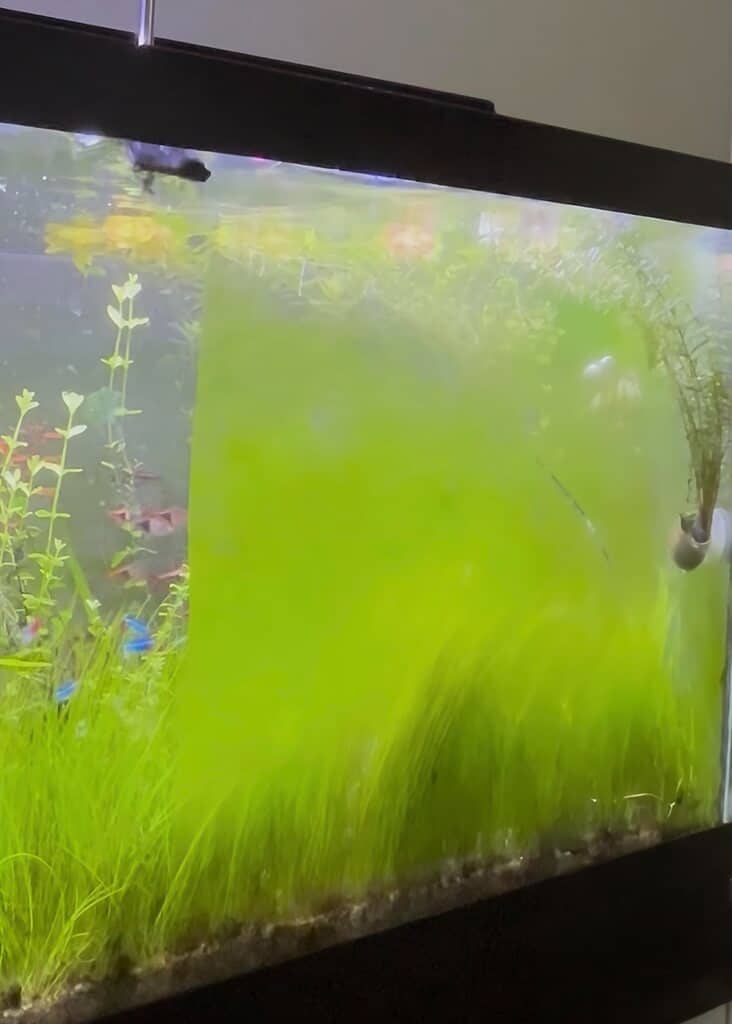
It can show up as a green film on the glass, green spots on your decorations, long green hair-like strings floating in the water, or even a full green water bloom that turns your tank into something that looks like pea soup.
The good news? Green algae is very manageable once you understand what causes it.
In this article, you will learn:
- What green algae is and why it shows up in your tank
- The different types of green algae and how to identify each one
- What causes each type and what to do about it
- How to prevent green algae from coming back
- Which fish, snails, and shrimp eat green algae
- When (and how) to use chemicals as a last resort
- How to connect the dots between your water parameters and algae growth
Stay with me and, after reading this, you will know exactly what to do.
Let’s go! ?
“I had a full green water outbreak — couldn’t see my fish at all. I tried water changes, nothing worked. After reading about UV sterilizers and cutting my light to 8 hours, the tank cleared up in 5 days. Game changer.”
Table of Contents
What is Green Algae?
Green algae are microscopic photosynthetic organisms that live in water. Just like your aquarium plants, they need three things to grow: light, nutrients, and CO2.
The problem is that your aquarium has all three in abundance! The aquarium light provides energy. Fish waste and uneaten food add nitrates and phosphates. CO2 comes from your fish themselves.
In small amounts, green algae are actually completely natural. In fact, many fish and invertebrates eat it. But when it gets out of control, it becomes a problem — it looks bad, blocks light from your plants, and in some cases can reduce oxygen levels in the water.
The key to tackling green algae is not just removing it — it’s **understanding why it appeared in the first place** and fixing that root cause.
If you only clean the glass without addressing the reason, it will always come back.
Is Green Algae Harmful to Fish?
In most cases, green algae is not directly harmful to your fish.
Your fish can live alongside some algae just fine.
However, there are a few situations where it can become a problem:
- Green Water Blooms: When algae cells multiply by the billions and float freely in your water, they can deplete oxygen levels at night, which can stress or harm your fish.
- Covering Plants: Heavy algae growth on your live plants can block light and eventually kill them.
- Clogging Filters: Algae can build up in your filtration system and reduce its efficiency.
Bottom line:
A little algae is fine. A lot of algae is a signal that something in your tank is out of balance — and you should act on it.
What Causes Green Algae in a Freshwater Aquarium?
Before you can solve an algae problem, you need to understand what’s feeding it.
There are three main causes:
Too Much Light
This is the most common cause. Your aquarium light is on for too many hours per day, or your tank is placed near a window and receives direct sunlight.
- Unplanted tanks should have the light on for a maximum of 6 to 8 hours per day.
- Planted tanks need 8 to 10 hours, but no more.
- Direct sunlight, even for just a few hours, can trigger massive algae blooms. Always keep your tank away from windows.
Pro tip: Use a simple plug-in timer for your light. It costs almost nothing and it makes a huge difference. Set it and forget it.
Too Many Nutrients (Nitrates and Phosphates)
Algae is a plant, and like all plants, it feeds on nutrients in the water. The main culprits are:
- Nitrate (NO₃): Should be kept below 20 ppm in a freshwater tank. Ideally below 10 ppm.
- Phosphate (PO₄): Should be kept below 0.5 ppm.
These nutrients come from fish waste, uneaten food, decaying plant matter, and sometimes your tap water itself.
Overfeeding is one of the biggest contributors. If your fish don’t eat all the food in less than a minute, you are feeding too much. That leftover food breaks down and becomes nitrates and phosphates — which then feeds algae.
Learn more about how to measure and control your water parameters [here]
Water Chemistry Imbalances
Sudden changes in water chemistry — especially pH swings — can also trigger algae outbreaks.
When your water parameters are unstable, it stresses your plants (which become weaker and less competitive against algae) and creates the kind of imbalanced environment where algae thrives.
This is one of the reasons why keeping a stable KH (carbonate hardness) is so important.
A good KH level acts as a buffer and helps prevent those dangerous pH swings that can set off an algae bloom.
Read more about KH and its connection to algae.
Types of Green Algae – How to Identify Them
Not all green algae are the same! Each type has a different cause and a different solution. Let’s look at the most common ones.
Green Spot Algae (GSA)
- What it looks like: Small, hard, circular green dots on the glass and on slow-growing plants like Anubias. Very difficult to scrape off with your finger — you need a blade.
- What causes it: Low phosphate levels, low CO2, or too much light. Interestingly, GSA often appears when phosphate is *too low*, not too high.
- How to identify it: Look for small, stubborn, perfectly round green dots on your glass and decorations. If it scrapes off easily, it’s probably not GSA.
Green Dust Algae (GDA)
- What it looks like: A soft, fine greenish coating on the glass that wipes off easily with your finger or a cloth.
- What causes it: Usually appears in newer tanks, or after water changes and disturbances. It is often a temporary phase that goes away on its own.
- How to identify it: It looks dusty, like someone wiped a green cloth on the glass. Easy to wipe off — this is the key difference from GSA.
Hair Algae / Thread Algae / String Algae
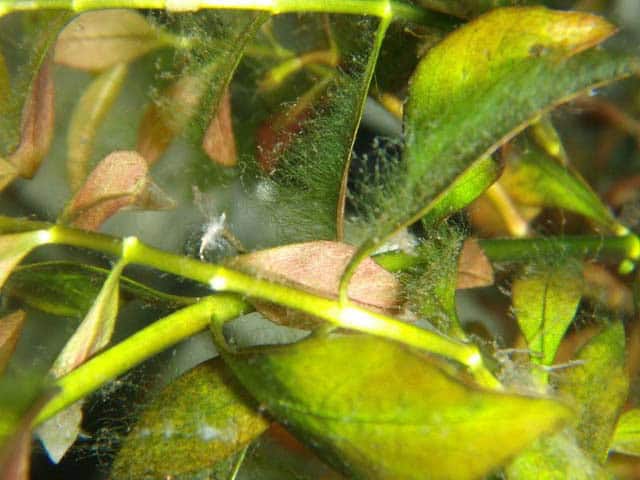
- What it looks like: Long, thin green strands or threads. They can grow on decorations, plants, rocks, or substrate. Sometimes they form floating clumps in the water.
- What causes it: Excess light and excess nutrients, especially phosphates. Also common when CO2 levels are inconsistent.
- How to identify it: It looks like green hair or strings. You can wrap them around a toothbrush or your finger. Some types float freely, others attach to surfaces.
Green Water (Phytoplankton Bloom / “Pea Soup”)
- What it looks like: The entire water column turns bright green. You can’t see your fish clearly. It looks like pea soup.
- What causes it: A sudden explosion of free-floating, single-celled algae (phytoplankton). Usually triggered by high ammonia in a new tank, excess nutrients, too much light, or nutrient spikes.
- How to identify it: The water itself is green — it’s not algae growing on surfaces. Your water looks cloudy and green.
Important: Water changes alone will NOT fix green water. The algae cells are in the water, and they will just repopulate quickly. You need a different approach for this one (more on that below).
Blue-Green Algae (Cyanobacteria)
Important note: Despite the name, blue-green algae is not actually an algae. It is a **cyanobacteria** — a type of bacteria that behaves like algae.
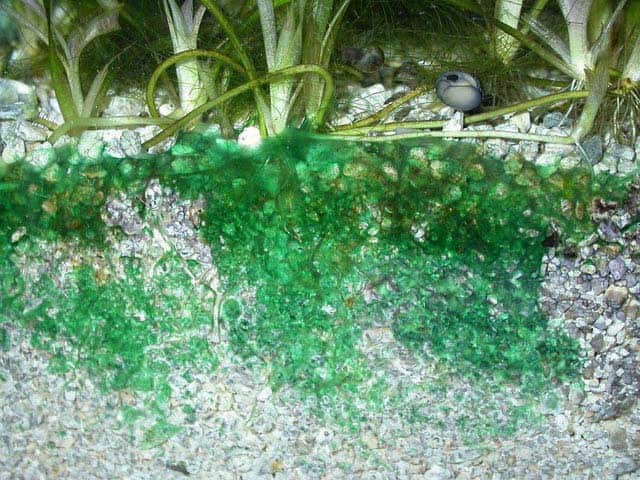
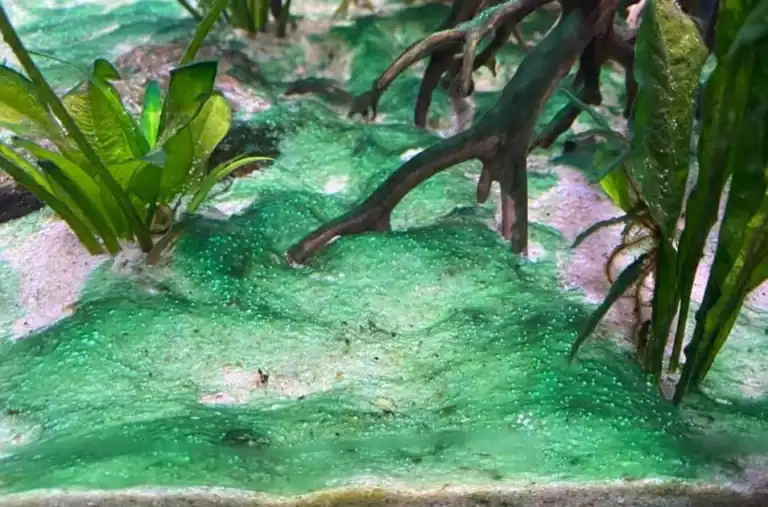
- What it looks like: A thick, dark blue-green or greenish-black film or “slime” that coats the substrate, rocks, plants, and decorations. It has a distinctive, unpleasant smell.
- What causes it: Low flow areas, excess nutrients, especially excess nitrate, low oxygen levels.
- How to identify it: It looks like a slimy, smelly blue-green carpet. It peels off in sheets.
Cyanobacteria is one of the more aggressive types and can suffocate your plants if not addressed quickly. We will cover how to deal with it below.
How to Get Rid of Green Algae – Solutions for Each Type
To get rid of algae you need to work on their immediate removal and also work on its cause.
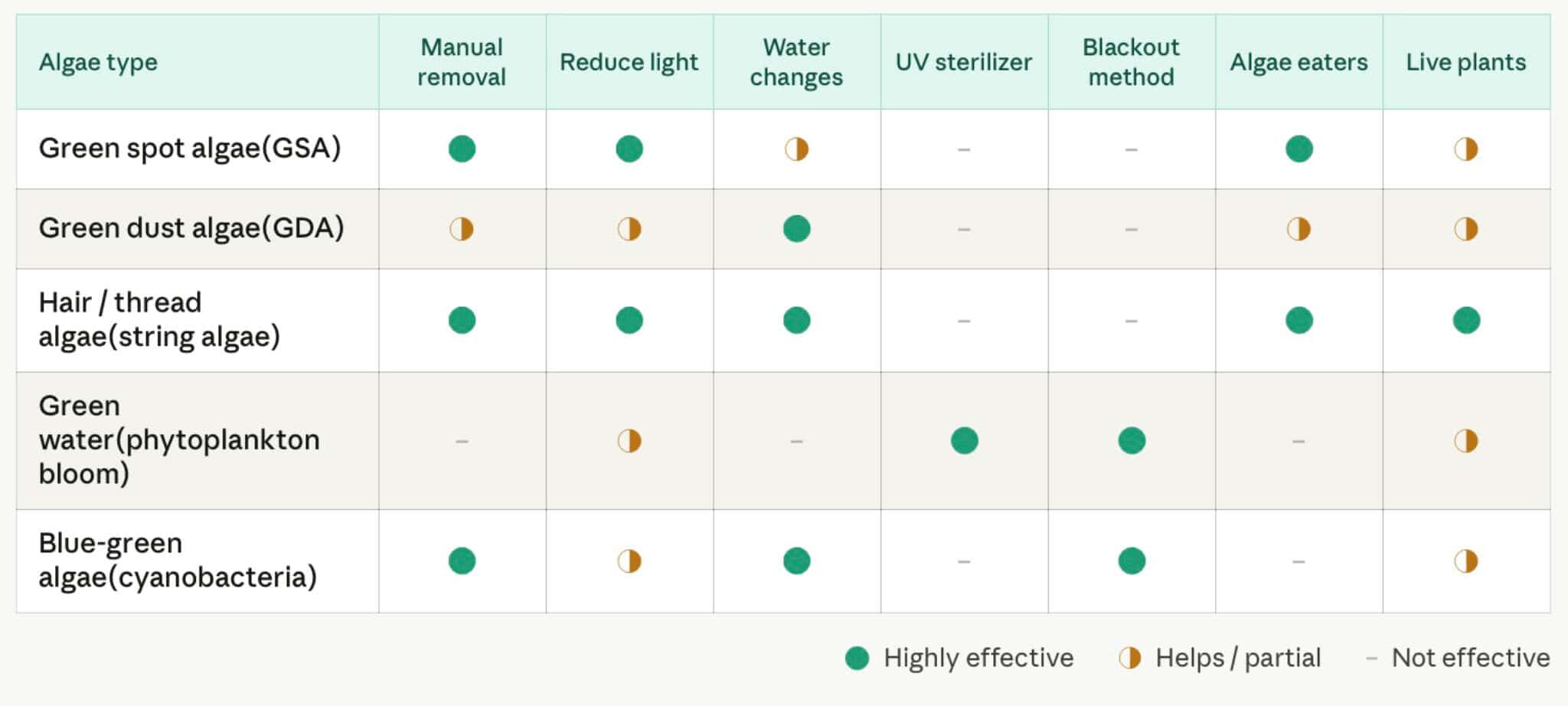
Getting Rid of Green Spot Algae (GSA)
- Scrape it mechanically: Use a razor blade or a hard algae scraper on the glass. On plants and decorations, try scrubbing with an old toothbrush.
- Check your phosphate levels: If phosphate is too low (below 0.1 ppm), increase it slightly by adding a phosphate fertilizer. This sounds counterintuitive, but GSA often thrives when phosphate is *scarce*, because it is better adapted to low-nutrient conditions than your plants are.
- Reduce light duration: Cut back to 8 hours per day and see if it slows down.
- Nerite snails: These are excellent at scraping GSA off glass and decorations.
Getting Rid of Green Dust Algae (GDA)
The best approach for GDA is actually to **leave it alone for 3 to 4 weeks**.
Let the algae complete its life cycle — then do a big water change and wipe the glass. The GDA will often not return after that.
If you constantly scrape it away, you disrupt the cycle and it keeps coming back. Patience is the secret here!
Getting Rid of Hair Algae / Thread Algae
- 1. Remove it manually: Use a toothbrush, twirl it around, and pull as much as you can out of the tank. Do this every few days.
- 2. Reduce light: Cut back to 8 hours or less. Use a timer.
- 3. Reduce phosphates: Do more frequent water changes, reduce feeding, and clean your filter.
- 4. Add fast-growing plants: Plants like Hornwort, Water Wisteria, and Guppy Grass will outcompete algae for nutrients.
- 5.Add algae eaters: Amano shrimp are *fantastic* at dealing with hair algae. More on that below.
Getting Rid of Green Water
Green water requires more specific solutions. Water changes alone will not work.
Option 1 – Blackout Method
Cover your tank completely with a blanket or dark material so that **zero light** reaches the water. Leave it for 3 to 4 days. The algae cells will die off because they can’t photosynthesize without light. Your fish will be fine. Your hardy plants should survive too, although delicate plants may suffer.
After the blackout, do a 30% to 50% water change and clean your filter. This is important because the dead algae cells will spike your ammonia if you leave them.
Option 2 – UV Sterilizer
This is the most effective and safest solution for green water. A UV sterilizer passes the water through a UV light chamber, which kills the free-floating algae cells without affecting your fish or plants.
After a few days, your water will clear up completely. Leave it running for at least 7 to 10 days to make sure all cells have been eliminated.
Option 3 – Diatom Filter
A diatom filter physically removes the algae cells by filtering them through diatomaceous earth. Very effective, but requires more maintenance than a UV sterilizer.
> For green water, my recommendation is the UV sterilizer. It is safe, effective, and once you have it, it also helps prevent future outbreaks.
Getting Rid of Blue-Green Algae (Cyanobacteria)
1. Siphon it out: Use your gravel vacuum to remove as much as you can manually.
2. Improve water flow: Add a powerhead or reposition your filter outlet to eliminate dead zones in the tank.
3. Blackout: 3 to 4 days of complete darkness works well for cyanobacteria too.
4. Erythromycin (antibiotic): This is a targeted antibiotic that is effective against cyanobacteria. However, use this only as a last resort** — it can disrupt your biological filter and harm your beneficial bacteria. If you use it, do several water changes afterward and add a good bacterial supplement like Seachem Stability to rebuild your cycle.
The Best Natural Algae Fighters: Fish, Snails, and Shrimp
One of the most fun and natural ways to manage green algae is to add some tank inhabitants that love eating it! Here are my favorites:
Algae-Eating Fish
- Otocinclus (Otos): Small, peaceful, and incredibly efficient at cleaning algae off glass and plants. Perfect for planted tanks. They come in groups, so buy at least 4 or 5 together.
- Bristlenose Pleco: Great for larger tanks. They eat algae off glass, rocks, and wood. Unlike common plecos, they stay small (4 to 5 inches) and don’t eat your plants.
- Siamese Algae Eater (SAE): One of the best for thread and hair algae. Make sure you are getting the real Siamese Algae Eater and not a look-alike species that doesn’t eat as much algae.
- -Mollies: Yes! Mollies are omnivores and they love to graze on algae. One more reason they are a great beginner fish. Read more about Molly Fish .
- Corydoras: They don’t eat algae directly, but they clean up uneaten food and organic debris from the substrate, which reduces the nutrients that feed algae.
Snails for Algae Control
- Nerite Snails: The gold standard for algae control. They eat green spot algae, green dust algae, and diatoms with incredible efficiency. They will not overrun your tank, as they need brackish water to reproduce. Perfect!
- Mystery Snails (Inca Snails): Large, beautiful, and effective. They eat algae from glass, decorations, and substrate. Great for tanks 15 gallons and above.
- Rabbit Snails: A more exotic option from Sulawesi, Indonesia. They love algae, stay manageable in numbers, and look gorgeous.
Shrimp for Algae Control
- Amano Shrimp: The best freshwater shrimp for algae control. Period. They are tireless workers and will clean hair algae, thread algae, and film algae like nothing else. Add them in groups of 5 or more for best results.
- Cherry Shrimp (Neocaridina)**: Great for smaller tanks and planted aquariums. They will eat soft algae and biofilm all day long.
Live Plants: Your Best Long-Term Defense
If you want to keep algae under control long term, the most effective strategy is **having a well-planted aquarium**.
Live plants and algae compete for the same resources — light, CO2, nitrates, and phosphates. When your plants are healthy, strong, and growing fast, they consume those resources before algae can get to them.
Key points:
- The more plants you have, the better. A heavily planted tank almost never has algae problems.
- Fast-growing stem plants are the most effective: Hornwort, Water Wisteria, Rotala, Hygrophila. They absorb nutrients incredibly quickly.
- Floating plants are also excellent: Frogbit, Water Sprite, Dwarf Water Lettuce. They absorb nutrients from the surface and also reduce light intensity, which directly inhibits algae.
- Slow-growing plants (Anubias, Java Fern, Bucephalandra) are beautiful but not very effective at outcompeting algae on their own.
If you are looking to get started with live plants, check out our article about Low Tech Planted Aquariums — you don’t need CO2 injection or expensive equipment to have a beautiful planted tank.
Water Parameters and Their Connection to Algae
This is something many hobbyists overlook, and it’s worth talking about.
Your water chemistry has a direct connection to algae growth. Here is what you need to know:
Nitrates and Phosphates
These are the main nutrients that feed algae. Test your water regularly. As a reminder:
- Nitrate: Keep below 20 ppm (ideally below 10 ppm). Learn more about Nitrates and all the other critical parameters.
- Phosphate: Keep below 0.5 ppm.
If your levels are high, increase the frequency of your water changes and reduce feeding.
pH Stability and KH
One of the indirect causes of algae is **pH instability**. When pH fluctuates, your plants get stressed and weaken, which gives algae a competitive advantage.
Your KH (carbonate hardness) is what protects you against pH swings. A good KH level (4 to 8 dKH) acts as a buffer and keeps your pH stable, which in turn keeps your plants healthy and competitive against algae.
Read our full guide about Water Hardness KH and GH to learn how to measure it and keep it in the right range.
Ammonia
High ammonia in new tanks is a very common trigger for green water blooms. This is one of the many reasons why you must always cycle your aquarium before adding fish.
If you are not familiar with the nitrogen cycle, don’t worry — we have a full guide on [Cycling Your Aquarium](https://www.cheapplantedaquarium.com/cycling-your-aquarium/) that walks you through it step by step.
**Quick reminder**: Even 0.25 ppm of Ammonia is toxic to fish. If you have a green water bloom in a new tank, always test your Ammonia first. Read more about Ammonia levels.
How to Prevent Green Algae from Coming Back
Prevention is always easier than treatment. Once you get your algae under control, here is how to keep it from coming back:
- 1. Use a timer on your aquarium light. Limit light to 8 hours per day for planted tanks, 6 to 8 for unplanted tanks. This is probably the single most effective thing you can do.
- 2. Don’t overfeed. Your fish should eat all their food in less than 1 minute. If there is leftover food after 1 minute, remove it and give less next time.
- 3. Do regular water changes. 20% to 30% every week or every two weeks, depending on your stocking level. This removes excess nutrients before algae can use them.
- 4. Clean your filter regularly. A dirty filter loses efficiency and allows nutrients to build up.
- 5. Keep your KH stable. A stable water chemistry means healthy, competitive plants and no opportunity for algae to take advantage. Check your water parameters regularly — here is how to do it.
- 6. Add live plants.More plants = less algae. It really is that simple.
- 7. Add algae eaters. A few Nerite snails, some Amano shrimp, or a small Otocinclus group can make a visible difference week over week.
- 8. Keep your tank away from windows. Sunlight, even indirect, significantly increases algae growth.
Chemical Solutions – Last Resort Only
I want to be honest with you: **chemicals should always be your last resource**, not your first.
They don’t fix the root cause of the algae. They just kill what’s there right now. If you don’t address the underlying issue — too much light, too many nutrients, unstable water — the algae will come back.
That said, there are times when the outbreak is so bad that you need chemical help to get it under control. Here are the most common options:
Algaecides
Algaecides are chemical products designed to kill algae. They can work, but use them with great care:
– Always remove your activated carbon from the filter before using them (carbon will absorb the chemical and reduce its effectiveness).
– Follow the dosage instructions exactly. Overdosing can harm your fish and beneficial bacteria.
– After the algae dies, do partial water changes every few days to remove the dead organic matter and prevent ammonia spikes.
– Algaecides can be harmful to invertebrates (shrimp, snails). Remove them from the tank if you plan to use chemical treatments.
Hydrogen Peroxide (Spot Treatment)
For spot treatments on hair algae or BGA patches, diluted hydrogen peroxide (3%) can be very effective.
Turn off your filter, use a syringe to apply a small amount directly on the algae patch, wait 5 minutes, then turn the filter back on. This is a localized treatment and much safer than dosing the whole tank.
UV Sterilizer for Aquariums: How It Works and How to Use It
For green water specifically, a UV sterilizer is the cleanest and most effective solution. It’s not a chemical — it uses ultraviolet light to kill the free-floating algae cells. Safe for fish, plants, and invertebrates. Highly recommended.
The cost is very reasonable. A good inline UV sterilizer for a tank up to 75 gallons costs around $30 to $60. The annual bulb replacement is $10 to $30. The electricity cost is minimal — most units use between 5 and 18 watts.
Check out this YouTube video to get an idea of how easy is to install a UV Water Filter.
Frequently Asked Questions
Is green algae in a fish tank bad?
In small amounts, no. A thin layer of green algae on the glass or decorations is completely natural and is even a food source for many fish and invertebrates. It becomes a problem when it gets out of control, covers your plants, or turns your water green.
Why does my fish tank keep getting green algae?
The most common reasons are: the light is on for too many hours per day, you are overfeeding, you are not doing water changes frequently enough, or your tank is near a window. Fix one or more of these and the algae will improve.
How do I get rid of green algae fast?
The fastest solution depends on the type. For glass algae, use a scraper. For green water, use a UV sterilizer or do a 3-day blackout. For hair algae, manual removal combined with Amano shrimp gives very fast results. Always combine removal with fixing the root cause.
Does green algae produce oxygen?
Yes! Like all plants, green algae photosynthesizes during the day and produces oxygen. However, at night it does the opposite — it consumes oxygen and produces CO2. In a severe green water bloom, this nighttime oxygen depletion can stress or even harm your fish.
How many hours of light should my aquarium have to prevent algae?
For planted tanks, 8 to 10 hours is ideal. For unplanted tanks, 6 to 8 hours maximum. Always use a timer — manual control is inconsistent and leads to the light being on too long.
Will more live plants really help with algae?
Absolutely, yes. This is probably the most effective long-term solution. Live plants compete directly with algae for light and nutrients. A heavily planted tank almost never has a significant algae problem.
References
For this article, I used my years of experience with freshwater aquariums, as well as information from the following trusted sources:
USGS – Water Science School: [usgs.gov] — for information about water chemistry and nutrient cycles.
University of Florida – IFAS Extension: [edis.ifas.ufl.edu](https://edis.ifas.ufl.edu) — for research on aquatic algae management and water quality in freshwater systems.
James Planted Tank: www.theplantedtank.co.uk/algae.htm
NOAA – National Oceanic and Atmospheric Administration: [noaa.gov](https://www.noaa.gov) — for background information on phytoplankton blooms and their environmental context.
What to Read Next
I hope this guide helped you understand green algae and gave you a clear plan to tackle it!
Here are some articles that pair perfectly with this one:
– [Freshwater Aquarium Water Parameters] – Learn to measure and control pH, Ammonia, Nitrites, Nitrates, and more. Essential reading for every aquarist.
– Water Hardness KH and GH – Understand how your water hardness connects to pH stability and algae growth, with a free online calculator.
– **[Low Tech Planted Aquarium] – The best long-term solution for algae is a planted tank. This guide shows you how to do it without expensive equipment.
Thank you very much for reading. Subscribe to my blog and I will let you know when we have new articles! ?
