How to Care for a Goldfish: A Complete Guide
Goldfish are sometimes loved and sometimes hated. People love them because they are beautiful, easy to care for, and can recognize and interact with their owners.
On the other hand, they mess up all your plants (not all but most of them – there are exceptions, and we will talk about them later here), they eat and poop a lot, and their sizes are not usually proportional to other fish, which bothers aquarists looking for an aesthetical fish tank.
Despite what others say about them, they are fantastic fish to have on your tank or your pound.
Keep reading and learn how to care for a goldfish!

Goldfish are one of the most famous and adored freshwater aquarium fish. Their scientific name is Carassius auratus, the Japanese Goldfish, Goldfish, and Kingy.

Table of Content
Goldfish History: Where do they come from?
The Goldfish is originally from China despite being classified as “Japanese.”
The first record of Goldfish dates back to 265 to 419 AD when it was mentioned in carp farming.
Some historians also say that the first appearance of the animal was recorded between 618 and 907 AD – Crazy, right?
The Japanese Goldfish is the result of the crossing of several carp brought from all regions of China for Emperor Zhao Gou. They were placed in the same tank and reproduced.
Then, they started populating home aquariums and mostly external ponds, like those in Japanese restaurants.
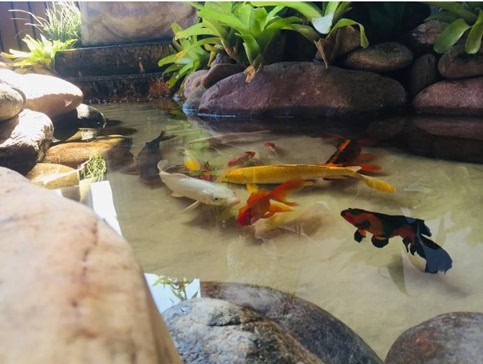
Exports to Japan only began in the early 1700s. Soon after, Goldfish reached Europe and spread throughout the Americas.
Nowadays, they are bred on a large commercial scale. To give you an idea, 2 million Goldfish are produced yearly in the US.
What is the ideal aquarium size for a Goldfish?
The ideal aquarium size for a Goldfish depends on its type. They usually need more space than other fish.
First, because they produce a lot of waste (they pop a lot).
Secondly, they are descendants of carp and need a lot of space (even though they are considered small animals).
The recommended tank size per Goldfish is 20 or 40 gallons, depending on its type:
- For the more common Goldfish (Comet, Shubunkin, Common Goldfish):
- Minimum: 40 gallons for the first fish
- Additional fish: +20 gallons per extra fish
- For the so-called Fancy Goldfish (Oranda, Ranchu, Fantail, Ryukin):
- Minimum: 20 gallons for the first fish
- Additional fish: +10 gallons per extra fish
Aquarium filtration for Goldfish tank
Goldfish produce a lot of waste. Consequently, the filtration system must be perfect and more potent than usual.
Your filter should process ten times the volume of water in your tank per hour. If your Goldfish tank is 20 gallons, your filter’s capacity should be 200 gallons per hour or more.
Remember that we are talking about a complete filtration system with a mechanical, chemical, and biological filtration layer (read mode here).
To recap, a complete filtration system has a first mechanical layer, which retains the coarsest dirt. Then comes the chemical one, which absorbs the substances dissolved in the water. Finally comes the biological one, which consumes ammonia.
What are the ideal Water parameters for Goldfish?
The ideal water parameters for Goldfish are listed below.
Temperature 65–75°F (18–24°C)
pH Level 7.0–8.0
General Hardness (GH) 100–200 ppm
Carbonate Hardness (KH) 70–140 ppm
Ammonia (NH₃) 0 ppm
Nitrite (NO₂⁻) 0 ppm
Nitrate (NO₃⁻) Under 20 ppm (max 40 ppm) Lower is better;
Oxygen Levels High Use air stones, filters, or surface agitation.
Goldfish are very sensitive to fast water parameter changes.
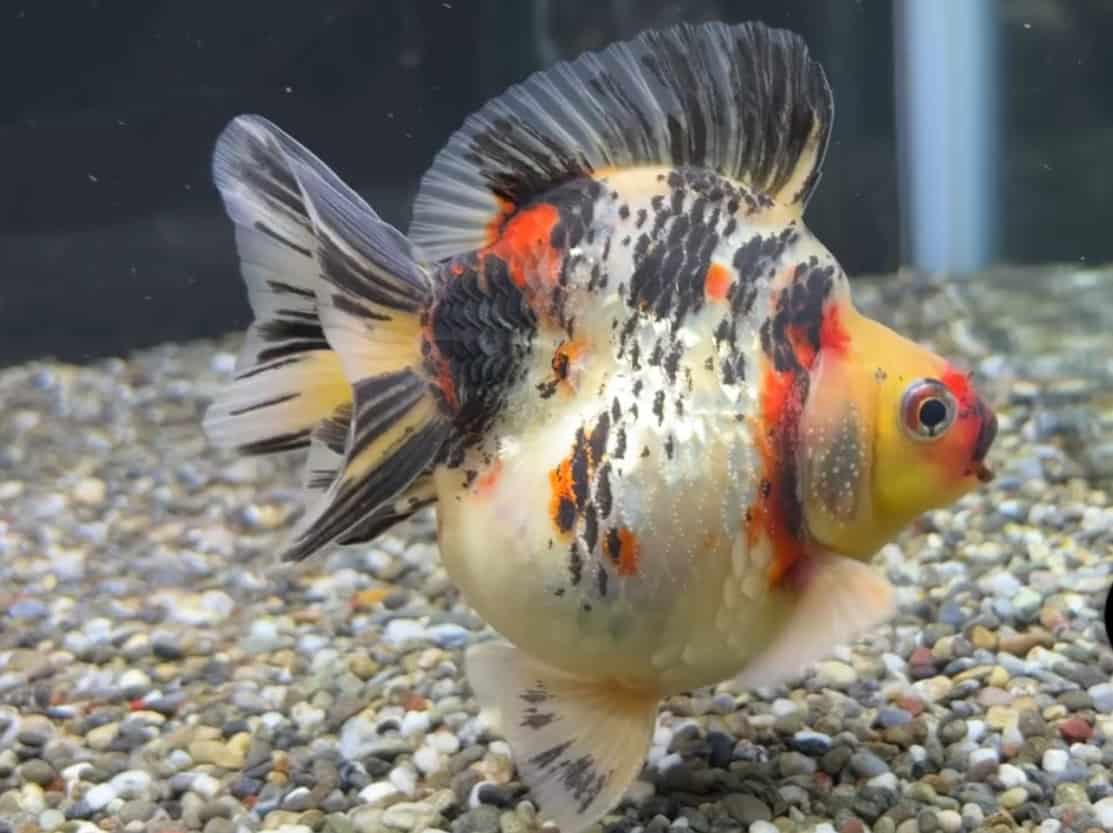
To maintain good water quality, partial water changes should be performed regularly, replacing an average of 20% to 40% of the volume every 7 to 10 days.
Feeding
Goldfish have a particularity: their stomach is not functional, and food passes through them intact and goes to the intestine, where digestion begins.
Because of this, it’s better to feed than less food but more than one time.
Feed them an amount of food they can eat in 30–60 seconds.
If food still floats after 1 minute, you’re feeding too much.
You feed too little if they eat everything in less than 30 seconds.
How long do Goldfish live?
Goldfish can live for about 10 years in aquariums and 30 years in ponds.
Best Tank Mates for Goldfish (And Which Fish to Avoid!)
The best fish mates to keep with your goldfish are:
- Other Goldfish
- Loaches (mainly Dojo Loaches)
- Smaller Plecos
- Rosy Barbs
- Koys
Avoid:
- Small fish as they can get eaten by your Goldfish.
- Neon Tetras
- Guppies
- Mollies
- Angelfish
- Male Betta Fish
- Cichlids like Oscars and Jack Dempseys as they can be too aggressive and will bully/eat goldfish.
- Avoid Large Plecos
How to breed Goldfish?
The reproductive period begins with the arrival of spring (August or September).
During this time, it is easier to differentiate between males and females.
Females usually have a larger belly.
Males have small white spots, similar to grains of sand, mainly around the operculum (structure that protects the gills) and on the pectoral fins and head.
These protrusions are called pearl organs, and their function is to attract and stimulate the female during courtship.
A 20 gallon (or more) fish tank is essential, where two males and one female will be placed.
The water column should be 10 inches (30 cm) to ensure a higher percentage of fertilized eggs — the temperature should be between 71 oF or 74 oF (22 and 24 ºC), and a pH between 6.8 and 7.5.
Floating plants such as water hyacinth and water lettuce are essential since the eggs will stay attached to their roots.
Spawning usually occurs early in the morning, and they become pretty agitated. The male tries at all costs to bring the female to the surface, close to the floating plants.
The female then begins to release eggs, which remain attached to the roots and leaves of the floating plants, where the males are responsible for fertilizing them.
This ritual can last a few hours, and a female goldfish can release 500 to 1000 eggs per spawning.
Once spawning is complete, all fish should be removed from the aquarium to prevent them from eating the eggs or fry.
The fertilized eggs are transparent and have two black dots, which are the eyes of the fish.
The time between spawning and hatching of the eggs depends mainly on the temperature and water quality. It usually varies from 3 to 10 days.
Do Goldfish Need an Air Pump?
Yes, an aerator is essential to oxygenate the water. Goldfish are cold-water fish that need more oxygen than other tropical fish.
How can I recognize if my Goldfish is a Male or Female?
Females have pectoral fins that are thin and delicate. Their anus is convex, forming a small “beak” pointing outwards. The female is generally larger, and during the breeding season, she has a large belly due to the egg deposits.
Male Goldfish have pectoral fins that are thicker, and if we touch them, we will notice they are rough and their anus is concave. During the breeding season, due to hormonal action, we will see white micronodules on their operculum (the part that covers the gills). They look like microspines (Pearl Organs).
Can I have plants in my Goldfish tank?
Yes, you can have plants in our Goldfish tank, but you must pick tough plants like, for example:
- Duckweed
- Anubias
- Java Ferns
- Crinum calamistratum.
- Vallisneria
- Amazon Sword
- Some mosses.
Fun fact – they can recognize music !
Did you know that goldfish can recognize music? Yeah, seriously, they can!
Some scientists decided to test this out. They played two different songs for a group of goldfish—one was a dramatic, spooky organ piece by Bach (Toccata and Fugue in D minor), and the other was a wild, chaotic composition by Stravinsky (The Rite of Spring).
Guess what?
The goldfish actually learned to tell the difference between them!
But then, the scientists got curious…
Do goldfish actually like music?
So, they set up an experiment where the fish could choose to hang out near different sounds.
Turns out, goldfish didn’t really care much about the music itself. They weren’t jamming out or picking favorites like we do.
What actually happened was that they hated noisy, unpleasant sounds and swam away from them fast!
If you’d like to read the full experiment, go to this page.
References
Goldfish Wikipedia here.
Amazing National Geographic article here
Reinforcing and discriminative stimulus properties of music in goldfish article here.
If you have questions or suggestions, reach out to me here.
